You’ve got a limited marketing budget, a to-do list that never ends, and someone is probably telling you that you need to “be on social media” while someone else insists you should “just run Google Ads.” So which is it?
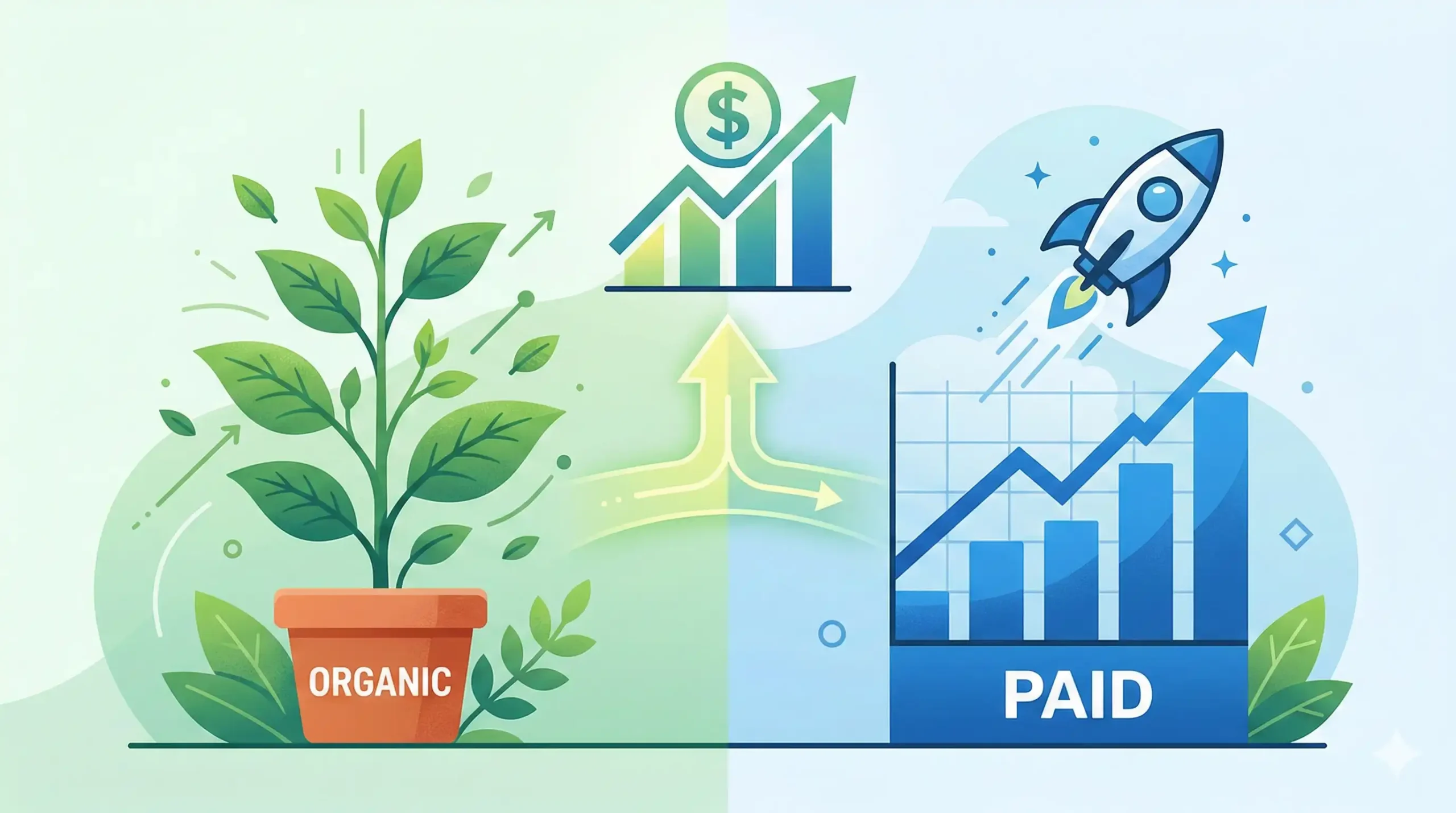
The frustrating truth — and the most useful one — is that organic and paid advertising aren’t competitors. They’re teammates. Small businesses that treat them as an either/or choice tend to plateau. The ones that learn to use both in tandem tend to grow.
Here’s what you need to know about each, and how to make them work together even if your budget is tight.
What Is Organic Advertising?
Organic marketing is everything you do to attract customers without paying for placement. Think blog posts, SEO, social media content, Google Business Profile updates, email newsletters, and word-of-mouth.
The key trait of organic marketing is that it compounds over time. A well-optimized blog post or a strong Google ranking keeps working for you months or years after you created it — without an ongoing dollar investment. That’s why 49% of marketers say organic search delivers their best marketing ROI, and why the top organic position on Google receives a click-through rate of nearly 27%.
The trade-off is time. It’s rare to see meaningful organic traffic growth in the first three months of optimization. For a brand-new business trying to get customers through the door next week, organic alone won’t cut it.
What Is Paid Advertising?
Paid advertising is exactly what it sounds like: you pay a platform — Google, Facebook, Instagram, LinkedIn — to place your message in front of a specific audience. You control who sees it, when, and what action you want them to take.
The advantage of paid advertising is speed and precision. Launch a Google Ads campaign today and you can have traffic within hours. Website visitors sourced from paid ads are 50% more likely to convert than organic visitors, largely because you’re targeting people with demonstrated intent to buy. And the average return on Google Ads investment sits around $8 for every $1 spent.
The catch is that the moment you stop spending, the traffic stops too. There’s no residual value. Paid advertising is like renting a storefront on a busy street — great foot traffic, but the moment your lease is up, customers stop finding you.
The Case for Organic: Building Something That Lasts
Organic marketing wins the long game. When you consistently publish helpful content, optimize your website for search, and maintain an active presence on the platforms where your customers hang out, you build something that paid ads can’t buy: trust.
Consumers are skeptical of advertising. Studies show that 70–80% of people regularly ignore paid digital ads. But they do trust search results, peer reviews, and brand content that’s helped them solve a problem. Organic marketing is how you earn that trust at scale.
Beyond trust, consider cost trajectory. As the digital advertising space grows more crowded, the cost per click on paid platforms keeps rising. Your organic asset — a high-ranking blog, a loyal email list, a well-reviewed Google Business Profile — holds its value regardless of what ad prices do.
Businesses that maintain a blog get 55% more website traffic than those that don’t, and organic search accounts for 53% of all web traffic globally. These aren’t numbers a small business can afford to ignore.
The Case for Paid: Results You Can Measure Right Now
So why not just go all-in on organic and skip the ad spend? Because organic marketing requires patience most small businesses don’t have the runway for.
If you open a new bakery, you can’t wait 12 months for your SEO to kick in. If you’re launching a new product or running a seasonal promotion, you need visibility now. That’s where paid advertising earns its place.
Paid ads also give you something organic marketing can’t: surgical targeting. You can put your ad in front of a 35-year-old homeowner within 10 miles of your shop who searched for “kitchen remodel contractor” in the last 48 hours. That kind of precision turns ad spend into a predictable acquisition engine, not a gamble.
And paid advertising doesn’t just drive direct sales. Research shows that 27% of consumers search for a business after seeing their display ad — even if they didn’t click. Paid ads build brand familiarity that eventually converts through organic channels. The two strategies are already feeding each other, whether you plan it that way or not.
Why Small Businesses Need Both: The Flywheel Effect
Here’s the real reason combining organic and paid is so powerful: they fix each other’s weaknesses.
Organic is slow to start but builds durable assets. Paid is fast but stops the moment you stop paying. When you run them in parallel, paid ads give you immediate revenue and data while your organic presence is developing. Then, as your organic rankings strengthen, you can reduce paid spend on high-traffic keywords while maintaining your paid focus on high-intent, high-conversion opportunities.
There’s also a feedback loop worth considering. Your paid ad campaigns reveal which messages, offers, and audience segments actually convert. You can take that information and build better organic content around it. Meanwhile, your organic content tells you which topics and keywords your audience cares about — giving you smarter targets for your paid campaigns.
Most successful small businesses allocate roughly 60–70% of their marketing effort to organic and 30–40% to paid advertising. For very early-stage businesses with tight budgets, leaning 80% organic while using paid strategically for product launches or seasonal pushes is a practical starting point.
A Practical Starting Point for Small Business Owners
You don’t need a massive budget to execute this well. Here’s a simple framework:
Start with organic foundations. Claim and optimize your Google Business Profile. Set up a basic SEO strategy for your website. Start publishing one helpful blog post per month. Build your email list. These efforts cost time, not money, and they pay off for years.
Use paid to amplify what works. Before spending on ads, see which of your organic content performs best. Then pay to boost that content — you already know people respond to it. This approach reduces wasted ad spend and accelerates what’s already working.
Let data guide budget allocation. Track which channels are driving leads, calls, and sales. If your Google Ads are generating consistent returns, scale them. If a particular blog post is sending qualified traffic, write more like it. Over time, you’ll develop an intuition for how to balance the two.
The Bottom Line
Organic marketing builds the foundation. Paid advertising builds the momentum. Neither works as well alone as it does when paired with the other.
Small businesses often make the mistake of waiting until they can “afford” to advertise, or abandoning organic because “it takes too long.” Both approaches leave money on the table. The businesses that grow consistently are the ones that invest in both — starting small, learning fast, and doubling down on what works.
You don’t have to be everywhere at once. But you do have to be building something lasting while you’re chasing results today.
Start with one organic channel and one paid campaign. Measure both. Then build from there.